Global Fishing Watch.
Fishing transparency for ocean monitoring and analysis.

Overview
Turned 22B AIS signals into investigative workflows—enabling analysis of 70,000+ fishing vessels across 50% of global oceans.
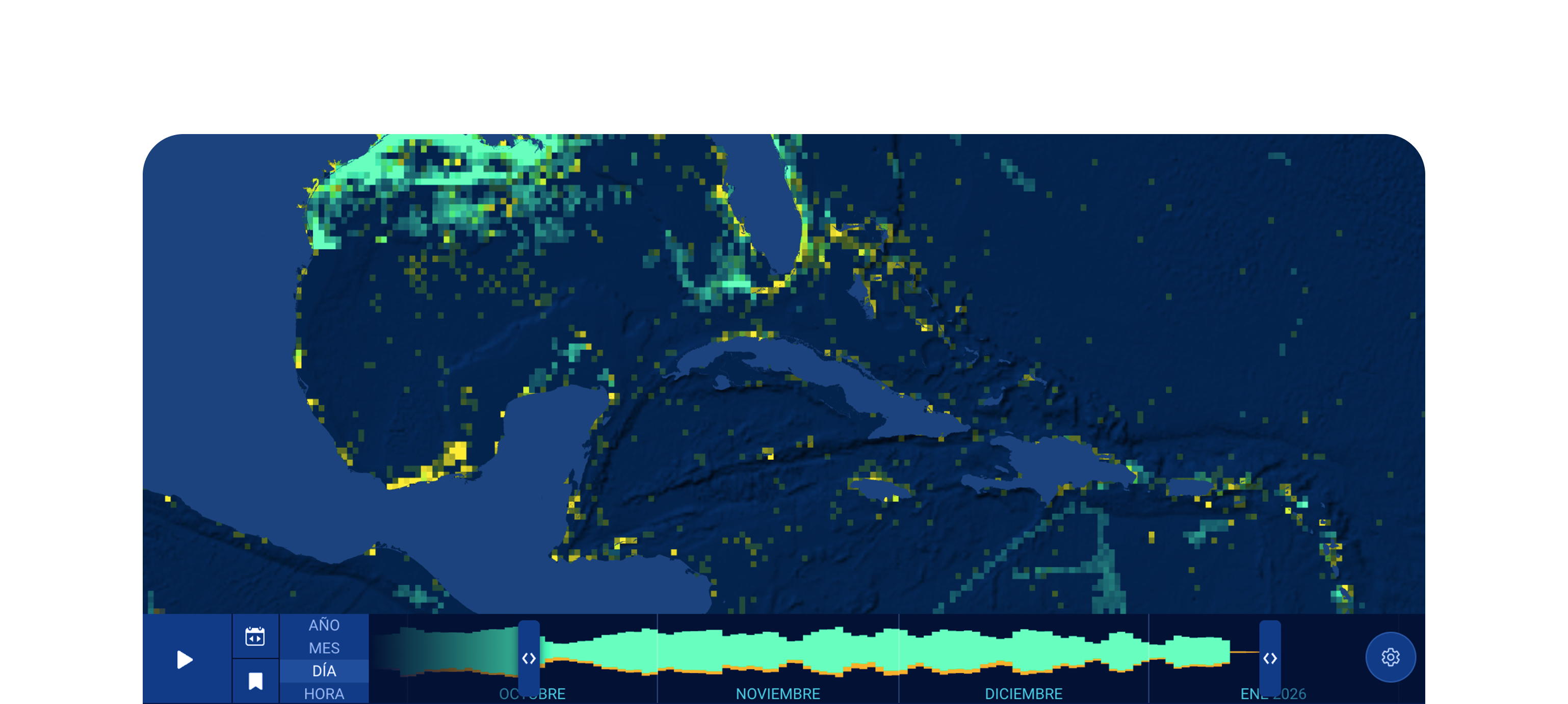
Global Fishing Watch started as a collaboration between NGOs and researchers to bring transparency to the high seas. The platform evolved from early prototypes into a widely used global monitoring tool, anchored by an investigation grammar (map + filters + timeline) that turns vessel-tracking signals into actionable evidence.
“A new era of ocean transparency, letting us see what happens beyond the horizon.” ⎯ Leonardo DiCaprio, announcing the launch of Global Fishing Watch.


Role: Senior Product Designer
Product Strategy & Design
Core Contributions:
- Designed the map experience to stay readable at global scale using grouping + progressive disclosure, so users could move from a global overview to actionable vessel sets without losing geographic context.
- Defined the filtering logic and interaction patterns to combine vessel activity + geospatial layers in one flow, enabling users to segment by vessel type, region, and behavior signals with fast iteration.
- Led the conceptualization and execution of a highly configurable timeline, allowing users to choose what data signals to show, set custom time windows, and switch between single-vessel deep dives and multi-vessel comparison.
- Designed the experience that kept map, filters, and timeline in sync, supporting investigation patterns like spotting anomalies, validating activity over time, and comparing multiple vessels within the same timeframe.
Product Journey Milestones
01
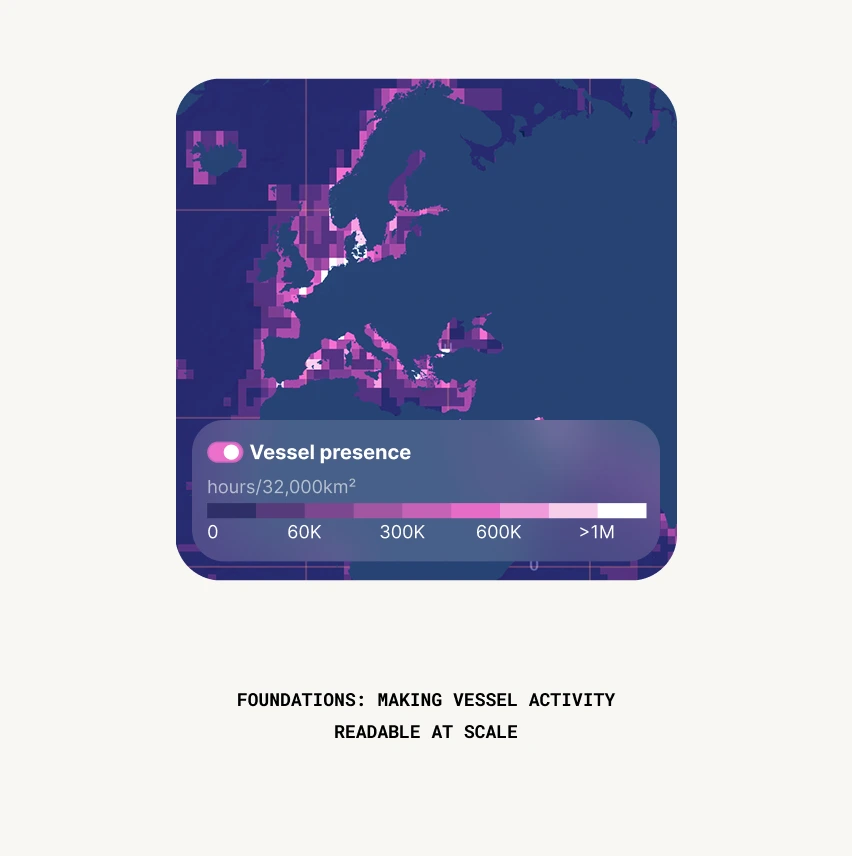
Built the core experience to move from raw AIS noise to clear patterns through grouping, filters, and progressive disclosure.
02
Expanded workflows by adding geospatial context (e.g., MPAs) so users could go from observation to planning-focused exploration.
.webp)
03
.webp)
Results
Measurable Impact
Made massive AIS data usable
Enabled analysts to work confidently with a dataset built from 22B AIS messages, tracking ~70,000 industrial fishing vessels since 2012.
Made concentration measurable
The experience helped reveal fishing as both widespread and concentrated: activity occurs across ~50% of the ocean, with more than half concentrated in just 0.5%.
Comparison workflows for detecting anomalies
Through timeline controls and multi-vessel comparison, the product supported analysts and stakeholders in spotting behavioral shifts over time and building evidence from patterns.
Designed to hold as coverage expanded
As tracking grew, the exploration model stayed robust across scale and time: datasets cover 2012–2024, based on >190,000 unique AIS devices, with up to ~96,000 active in a given year.